Ready to get started?
Transform your ESG reporting with expert support.
Calculating a carbon footprint for a bank or corporate client is rarely as hard as it sounds. In most cases, you only need to calculate Scope 1 and Scope 2 emissions — fuel you burn directly and electricity you buy — using data you already have on file, like fuel receipts and utility bills. A first calculation typically takes hours, not weeks.
How hard is it to calculate a carbon footprint?
Most of the fear around carbon footprinting comes from assuming you need to map your entire value chain on day one. You don't. Banks responding to EBA guidelines and corporate clients responding to CSDDD due diligence requirements almost always start by asking for Scope 1 and Scope 2 — the emissions inside your own operations. That's a bounded, well-defined calculation, not an open-ended research project.
What are Scope 1 and Scope 2 emissions?
Under the Greenhouse Gas (GHG) Protocol Corporate Standard, the global standard behind virtually every carbon footprint, Scope 1 and Scope 2 cover:
- Scope 1: direct emissions from things you own or control — company vehicles, boilers, generators, and on-site fuel combustion
- Scope 2: indirect emissions from energy you purchase — mainly electricity, plus any purchased heating, cooling, or steam
Do banks and corporate clients also ask for Scope 3?
Sometimes, but rarely as a first step. Scope 3 covers everything in your value chain — your suppliers' emissions, business travel, product use — and it's the hardest category to measure precisely for anyone, including large companies with dedicated sustainability teams. VSME's Basic Module doesn't require it, and most bank credit reviews or supplier questionnaires are satisfied by a solid Scope 1 and Scope 2 number first. If Scope 3 comes up, it's usually one or two specific categories your customer already cares about, not the full inventory.
What data do you need to calculate Scope 1 and Scope 2?
You almost certainly already have it:
- Fuel receipts or fuel card statements for company vehicles and equipment
- Heating fuel invoices — gas, heating oil, or LPG
- Electricity bills, in kWh, for each site
- Purchased heating, cooling, or steam invoices, if applicable
- Refrigerant top-up records, for sites with air conditioning or refrigeration
How do you actually calculate it?
The method is the same whether you do it by hand or with software:
- Gather activity data for the reporting period — litres of fuel, kWh of electricity, kilometres driven
- Multiply each figure by the relevant emission factor, published for your country and fuel or energy type
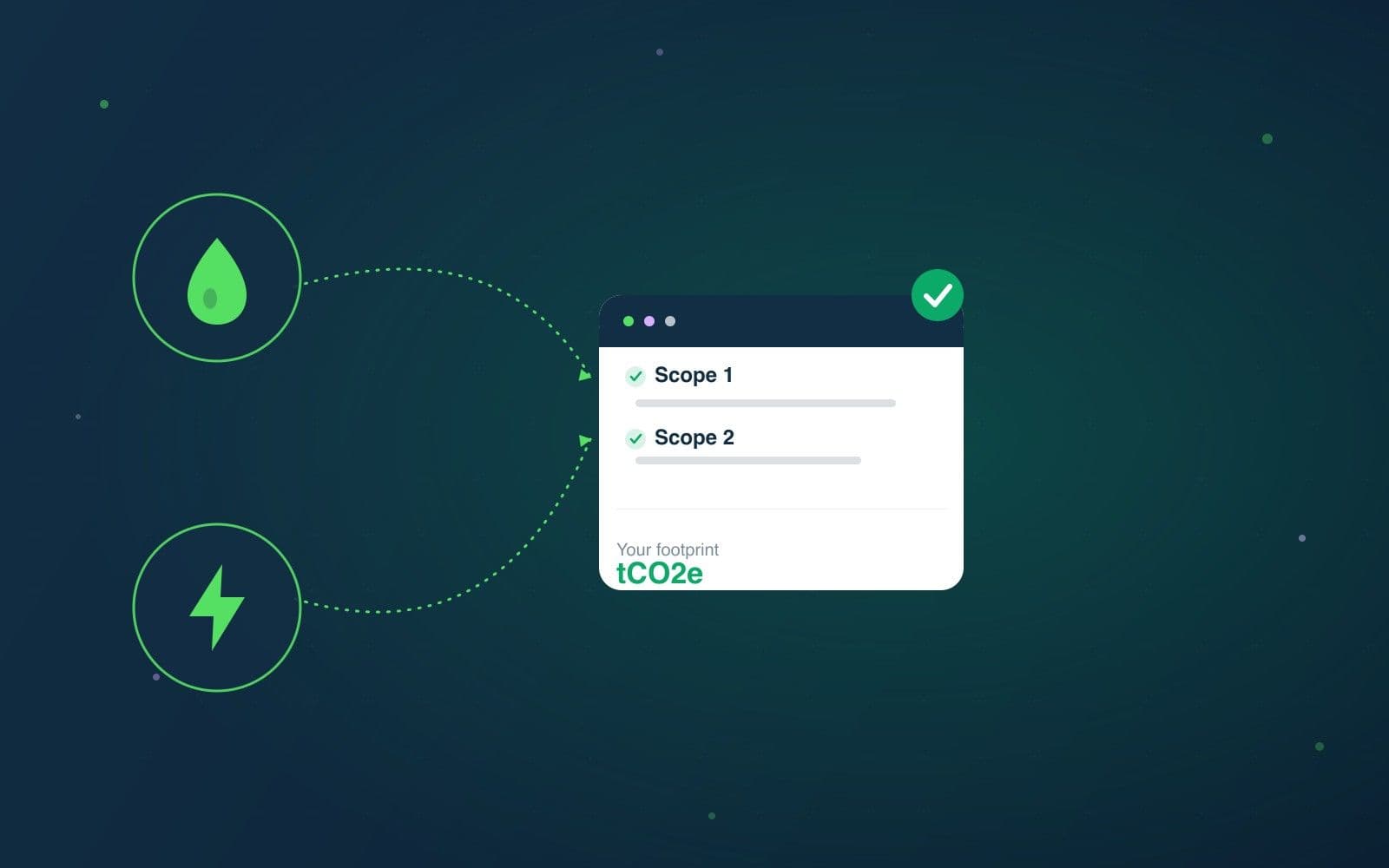
- Add the results together and convert to tonnes of CO2-equivalent (tCO2e)
That's the entire calculation. There's no missing step or hidden complexity — it's arithmetic applied to data you're already collecting for accounting or operations.
How long does it really take?
With your bills and meter readings in one place, most SMEs can produce a first Scope 1 and Scope 2 footprint in a day or two. The slow part is usually chasing down scattered invoices, not the calculation itself — which is exactly the part a structured process, or the right tool, removes.
How Sustainly makes it even easier
Sustainly connects to your existing bills and data sources, applies the correct emission factors automatically, and classifies everything into Scope 1 and Scope 2 for you — so you get a footprint you can hand to your bank or corporate client without spending days in spreadsheets. It stays current as new bills come in, so you're not starting from zero the next time someone asks. If a customer or lender has just requested your carbon footprint, you can have a credible answer ready this week, not next quarter.