Ready to get started?
Transform your ESG reporting with expert support.
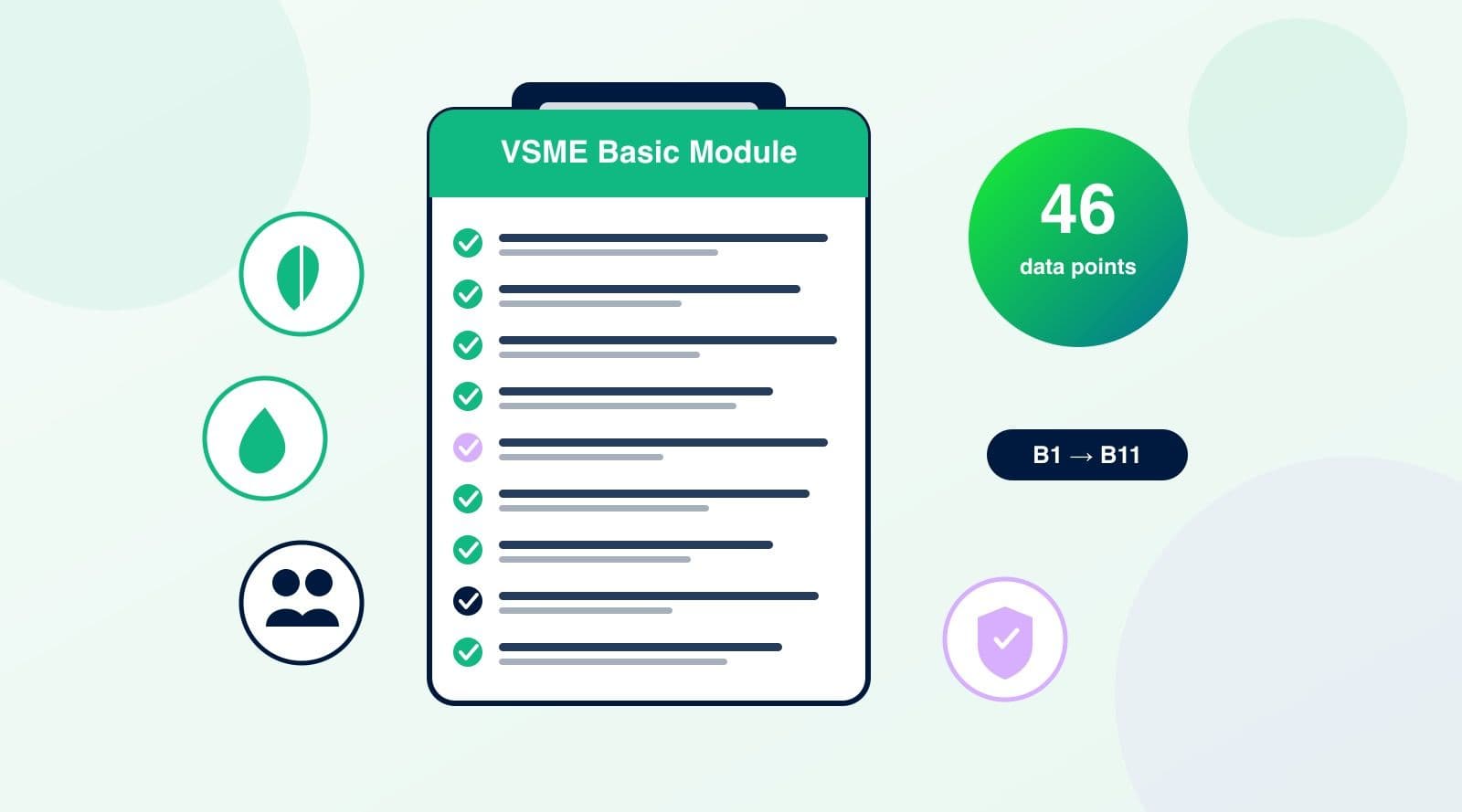
If a bank, a corporate customer, or your own management team has asked for a VSME sustainability report, the first real question is simple: what exactly do you have to report? The Voluntary reporting standard for non-listed micro-, small- and medium-sized undertakings (VSME), published by EFRAG, answers that with the Basic Module — eleven disclosure requirements, B1 to B11, that break down into a manageable set of concrete VSME basic module data points. This guide explains every one of them, one by one, so you can turn a dense EU standard into a working VSME checklist.
EFRAG doesn't publish a single official line count for the Basic Module — depending on how you split composite disclosures (like the B2 practices-and-policies matrix, or B5's optional land-use metrics), different VSME reporting standard guides cite anywhere from around 40 to over 55 items. Below, we break the Basic Module into 46 individual, reportable data points, a granularity that matches how most VSME checklist and VSME template tools structure the standard in practice. Every item maps directly back to the official VSME Standard text, so you can use this as your working checklist regardless of which counting convention a particular tool uses.
What Is the VSME Basic Module?
The VSME standard gives non-listed SMEs two ways to report: the Basic Module (B1–B11) and the Comprehensive Module (C1–C9), which sits on top of it. The Basic Module is the entry point — EFRAG designed it as the target approach for micro-undertakings, and as the minimum requirement for anyone else using the standard. It covers four areas: general company information (B1–B2), environmental metrics (B3–B7), social and workforce metrics (B8–B10), and one governance metric (B11).
Unlike CSRD and ESRS reporting, VSME is voluntary and proportionate by design — many of its data points only apply 'if applicable'. Pollution disclosures, for instance, only kick in if you're already required to report emissions elsewhere, and the gender pay gap is optional below 150 employees. That's exactly why a data-point-by-data-point walkthrough is more useful than a summary: you need to know which of the 46 actually apply to your business before you start collecting data.
Who Actually Needs This VSME Checklist
VSME reporting typically gets triggered by one of three requests:
- A corporate customer in scope of CSRD asking you, as a supplier, for sustainability data to feed their own value-chain reporting.
- A bank or lender assessing non-financial risk as part of a loan, credit line, or renewal review.
- Your own leadership wanting a lightweight starting point for sustainability management, without adopting full ESRS.
If you're new to why VSME exists and how it fits alongside CSRD, our earlier guide on navigating the VSME standard is a good starting point. If your question is specifically whether a customer or bank can legally require this from you, see VSME reporting: the only ESG standard you can be asked for outside CSRD scope. And if it was your bank that asked, this guide to non-financial data and lending explains why. This article assumes that context and goes straight into the data points themselves.
The VSME Basic Module Checklist: All 46 Data Points
The Basic Module is organised into eleven disclosure requirements. We've kept the official B1–B11 numbering and EFRAG's own wording as closely as possible, so you can cross-reference this checklist directly against the standard.
B1 — Basis for Preparation (data points 1–12)
B1 sets the foundation: who you are, how big you are, and how you're reporting. All twelve data points are mandatory.
- 1. Reporting option selected — state whether you're using the Basic Module only, or the Basic Module together with the Comprehensive Module.
- 2. Confidentiality omissions — flag any disclosure you've left out because it's classified or commercially sensitive, and name which one.
- 3. Reporting basis — say whether the report covers your undertaking alone (individual basis) or includes subsidiaries (consolidated basis).
- 4. Subsidiaries and registered addresses — if you report on a consolidated basis, list every subsidiary covered, with its registered address.
- 5. Legal form — your undertaking's legal structure: private limited company, sole proprietorship, partnership, cooperative, or other.
- 6. NACE sector code(s) — the EU's standard classification code(s) for your economic activity.
- 7. Balance sheet total — total balance sheet size, in euro.
- 8. Turnover — net turnover, in euro. This figure also feeds the GHG intensity calculation under B3.
- 9. Number of employees — headcount or full-time equivalent (FTE).
- 10. Country of primary operations — plus the location of any significant assets.
- 11. Geolocation of sites — coordinates for every site you own, lease, or manage; useful for assessing climate and biodiversity risk.
- 12. Sustainability certifications or labels — any eco-labels or sustainability certifications you hold, with issuer, date, and rating where relevant.
B2 — Practices, Policies and Transition Initiatives (data points 13–16)
B2 is a single, structured disclosure about your sustainability management approach. EFRAG's own template asks the same four questions across ten topics — climate change, pollution, water and marine resources, biodiversity, circular economy, own workforce, workers in the value chain, affected communities, consumers, and business conduct. For a data-point count, we treat the four underlying questions as the data points:
- 13. Practices in place — whether you already have concrete sustainability practices, for example reducing water or electricity use, cutting emissions, or improving working conditions.
- 14. Policies and public availability — whether you have formal sustainability policies, and whether they're publicly available.
- 15. Future initiatives — any forward-looking sustainability plans you're implementing.
- 16. Targets and progress — whether you've set targets tied to those policies or initiatives, and how you're tracking against them.
B3 — Energy and Greenhouse Gas Emissions (data points 17–20)
B3 is the core carbon disclosure, and usually the one corporate customers and banks ask for first.
- 17. Total energy consumption — in MWh, broken down by electricity and fuels, and by renewable vs. non-renewable where you can get the data.
- 18. Scope 1 GHG emissions — direct emissions from sources you own or control, in tCO2e, following the GHG Protocol Corporate Standard.
- 19. Scope 2 GHG emissions, location-based — indirect emissions from purchased electricity, heat, steam, or cooling.
- 20. GHG intensity — your total emissions divided by turnover, giving a size-adjusted figure that's easier for banks and customers to compare across suppliers.
B4 — Pollution of Air, Water and Soil (data point 21)
B4 is conditional — it only applies if you're already legally required to report pollutant emissions, or you already do so voluntarily under an environmental management system such as EMAS or ISO 14001.
- 21. Pollutants emitted to air, water and soil — the type of each pollutant and the quantity released, by medium. If the data is already public elsewhere, you can link to it instead of repeating it.
B5 — Biodiversity (data points 22–27)
Two data points here are mandatory if they apply to you; four more are entirely optional but worth including if you can measure them easily.
- 22. Number of sites in or near biodiversity-sensitive areas — mandatory if you have any such sites.
- 23. Total area of those sites — in hectares.
- 24. Total land use — optional.
- 25. Total sealed area — optional.
- 26. Nature-oriented area on-site — optional.
- 27. Nature-oriented area off-site — optional.
B6 — Water (data points 28–29)
- 28. Total water withdrawal — including the portion withdrawn at sites located in high water-stress areas.
- 29. Water consumption — required only if you run water-intensive processes such as drying, irrigation, or certain production processes; calculated as withdrawal minus discharge.
B7 — Resource Use, Circular Economy and Waste Management (data points 30–33)
- 30. Circular economy principles — whether you apply them, and a brief description of how.
- 31. Waste generated — total annual waste, split between hazardous and non-hazardous.
- 32. Waste diverted to recycling or reuse — the portion of that waste that avoids landfill or incineration.
- 33. Mass-flow of significant materials — annual volumes of key raw materials or inputs, required only for sectors with significant material flows such as manufacturing, construction, or packaging.
B8 — Workforce: General Characteristics (data points 34–37)
- 34. Employees by contract type — temporary vs. permanent, in headcount or FTE.
- 35. Employees by gender.
- 36. Employees by country of employment contract — only if you operate in more than one country.
- 37. Employee turnover rate — required only once you employ 50 or more people.
B9 — Workforce: Health and Safety (data points 38–40)
- 38. Number of recordable work-related accidents.
- 39. Rate of recordable work-related accidents.
- 40. Fatalities — resulting from work-related injury or work-related ill health.
B10 — Workforce: Remuneration, Collective Bargaining and Training (data points 41–44)
- 41. Minimum wage compliance — whether employees are paid at or above the applicable minimum wage, whether set by national law or a collective agreement.
- 42. Gender pay gap — the percentage gap between female and male pay. You may omit this below 150 employees, a threshold that drops to 100 from 7 June 2031.
- 43. Collective bargaining coverage — the percentage of employees covered by a collective bargaining agreement.
- 44. Training hours — average annual training hours per employee, broken down by gender.
B11 — Convictions and Fines for Corruption and Bribery (data points 45–46)
The only governance disclosure in the Basic Module, and one you only need to populate if something actually happened during the reporting period.
- 45. Number of convictions — for violations of anti-corruption or anti-bribery law during the reporting period.
- 46. Total fines incurred — the corresponding financial penalties.
Turning This VSME Checklist Into a Reusable VSME Template
A checklist only becomes a VSME template once you can reuse it every year without starting from scratch. Three habits make the difference: pull data from sources you already have (utility bills, payroll and HR systems, purchasing records) rather than creating new processes; assign a named owner for each of the eleven B-sections, since B1 and B8–B10 usually sit with finance or HR while B3–B7 sit with operations or facilities; and record 'not applicable' explicitly, with a one-line reason, rather than leaving a data point blank — this mirrors how B1 itself asks you to flag omitted disclosures, and it saves you from re-litigating the same scoping question next year.
If a customer or bank has asked you for supplier-level carbon figures specifically, our guide to cost-effective supplier carbon footprinting walks through the Scope 1 and 2 calculation in B3 in more detail, and this article on responding to customer sustainability requests covers how to scope and prioritise the request itself.
Basic Module vs. Comprehensive Module: When You Need More Than 46
The Basic Module is designed to stand on its own, but some banks, investors, and large corporate customers ask for more. The Comprehensive Module adds nine further disclosures, C1 to C9, covering your business model and strategy, Scope 3 emissions and climate transition planning, climate-related risks, additional workforce and human-rights information, revenue from specific sensitive sectors, and gender diversity in governance. You only need to look at the Comprehensive Module once a specific counterparty asks for it, or once you decide the extra detail is useful for managing your own risk — the Basic Module's 46 data points remain a complete, standalone VSME reporting standard submission on their own.
Whether you're filling this out for the first time or standardising it as an annual VSME template, the fastest path is to treat each of these 46 data points as a discrete, ownable task rather than one large reporting project. Sustainly's VSME workflow turns this exact checklist into guided, exportable reporting, built for SME teams rather than sustainability consultants.
Wondering exactly what a customer is legally allowed to ask you for? The VSME Value Chain Cap: What It Means When a Customer Sends You an ESG Questionnaire breaks down the value chain cap that limits ESG questionnaires to protected undertakings.
Not sure if CSRD still applies to you at all? Post-Omnibus: Who Still Has to Report Under CSRD in 2027 (and Who Just Got a Customer Instead of a Regulator) walks through the new 2027 scope thresholds and what changes if you fall out of them.
Not sure how VSME relates to the other ESG standards you keep hearing about? VSME vs ESRS vs GRI vs GHG Protocol: Which Standard Actually Applies to You compares them side by side and shows which one actually applies to you.