Ready to get started?
Transform your ESG reporting with expert support.
Four acronyms keep showing up in the same conversations — VSME, ESRS, GRI, and the GHG Protocol — and they get treated as if you have to choose one, like picking a software vendor. You don't. They're not four competing versions of the same thing; they operate at different levels, and for most SMEs only one of them is actually the reporting standard you use, while another is a calculation method that sits underneath it. This guide untangles which is which, and which one applies to you.
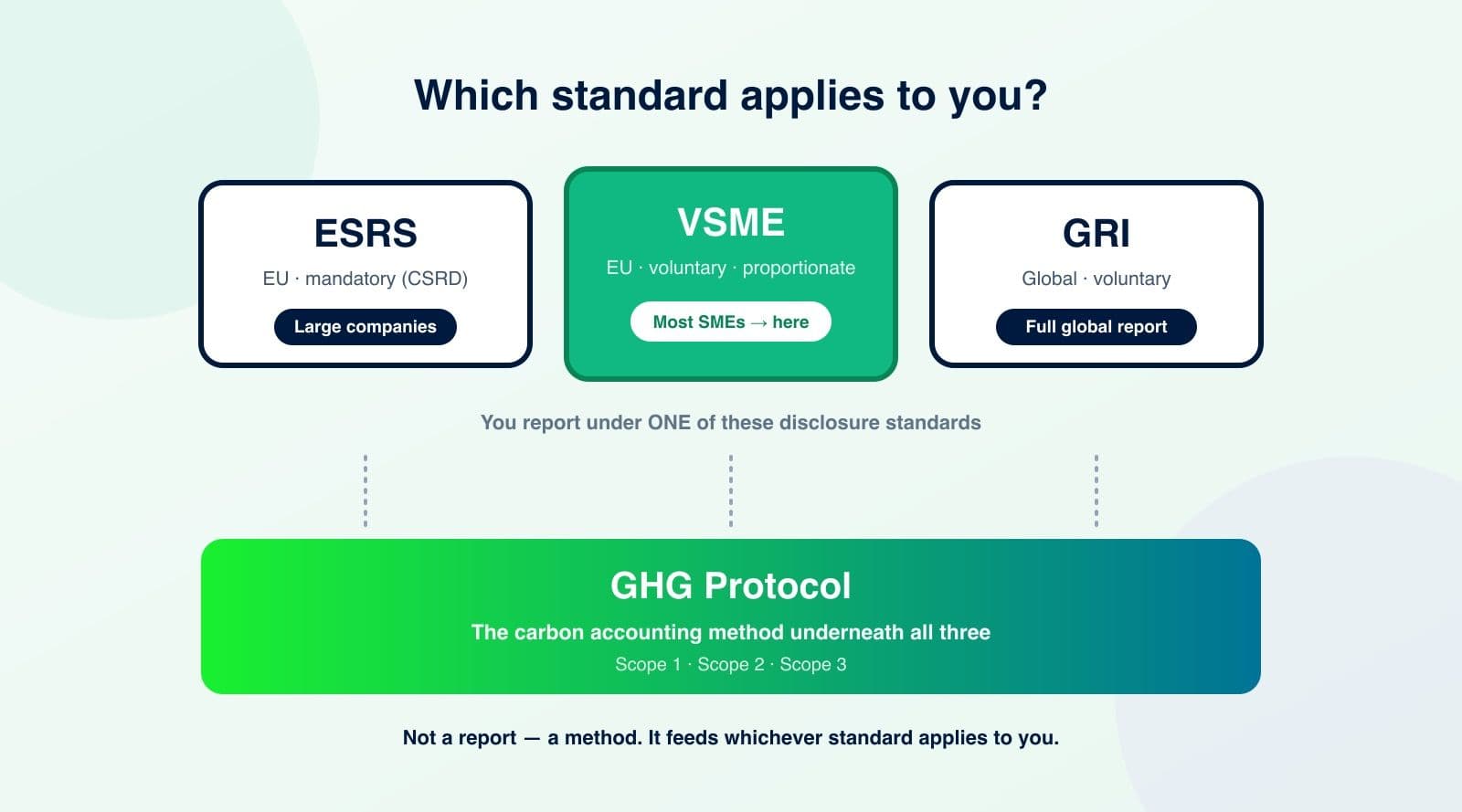
The short version: ESRS is the mandatory EU standard for large companies in CSRD scope. VSME is the voluntary, proportionate standard for everyone smaller. GRI is a long-established global framework used voluntarily worldwide. And the GHG Protocol isn't a disclosure standard at all — it's the carbon accounting method the other three rely on for their emissions numbers. Here's how that plays out in practice.
The Four Standards at a Glance
Before the detail, the one-line version of each:
- ESRS (European Sustainability Reporting Standards) — the detailed, mandatory disclosure standard companies must use to report under the EU's CSRD. Built around double materiality.
- VSME (Voluntary SME Standard) — EFRAG's proportionate standard for micro, small, and medium-sized undertakings outside mandatory scope. A fraction of the data points, designed to be answerable without a sustainability department.
- GRI (Global Reporting Initiative) — the oldest and most widely used global sustainability reporting framework, voluntary, focused on your impacts on people and the environment.
- GHG Protocol — not an ESG reporting standard but a carbon accounting methodology: the rules for calculating Scope 1, 2, and 3 greenhouse gas emissions that the other standards then ask you to disclose.
VSME vs ESRS: the Same Family, Very Different Sizes
VSME and ESRS are the closest pair here, because both come from EFRAG and both sit inside the EU's sustainability reporting architecture. The difference is scale and obligation. ESRS is mandatory for companies in CSRD scope and is genuinely heavy — over a thousand potential data points across ten topical standards, built on double materiality, meaning you assess both how sustainability issues affect your business financially and how your business affects people and the planet.
VSME is the deliberately lightweight counterpart: a Basic Module of roughly 46 data points, no formal double-materiality assessment required, and a structure a small company can complete from data it already has. If you're not legally required to use ESRS, VSME is almost certainly the standard you actually want — we break down exactly what it contains in our guide to the VSME Basic Module’s 46 data points.
The practical question, then, isn't "VSME or ESRS?" as a preference — it's "am I in CSRD scope?" If you are, ESRS is mandatory. If you're not, VSME is the proportionate choice. Since the Omnibus I reform sharply narrowed who falls under CSRD, far fewer companies now need ESRS than the original rules implied — our guide to post-Omnibus CSRD scope in 2027 walks through exactly where that line now sits.
GRI vs ESRS: Global and Voluntary vs. EU and Mandatory
GRI is the standard people often already know, because it's been the default global sustainability reporting language for two decades. It's voluntary, used by companies worldwide regardless of jurisdiction, and modular — universal standards plus topic-specific ones. Its materiality lens is impact materiality: it asks what your most significant impacts on the economy, environment, and people are, looking outward from the company.
ESRS, by contrast, is EU-specific, mandatory for those in scope, and uses double materiality — impact materiality plus financial materiality. The two were deliberately designed with a high degree of interoperability, and for many topics the underlying data overlaps heavily, so a company reporting under one isn't starting from scratch for the other. That said, the EU's post-Omnibus revisions to ESRS have introduced some divergence, so the alignment is close but no longer perfect.
For an SME, the takeaway is simpler than the comparison suggests: GRI is a serious framework, but it's aimed at organisations choosing to produce a full, standalone sustainability report for a global audience. It's usually more than a smaller company needs to satisfy a customer or bank request — which is exactly the gap VSME was created to fill.
Where the GHG Protocol Fits: It’s a Method, Not a Report
The GHG Protocol is the one that's categorically different, and the most commonly misunderstood. It isn't a sustainability reporting standard you report 'under' — it's the accounting methodology for calculating greenhouse gas emissions, splitting them into Scope 1 (direct), Scope 2 (purchased energy), and Scope 3 (value chain). When ESRS, VSME, or GRI ask you for your emissions, the number you give them is calculated using the GHG Protocol.
That's why it isn't an either/or with the others: you use the GHG Protocol underneath whichever disclosure standard applies to you. A single set of emissions figures, calculated once to the GHG Protocol, can feed a VSME report, an ESRS submission, and a GRI disclosure alike. If a customer or bank has asked specifically for your carbon numbers, our guide to cost-effective supplier carbon footprinting covers how that Scope 1 and 2 calculation actually works.
So Which One Applies to You?
Work down this list and stop at the first one that fits:
- If your company is in CSRD scope (broadly, an EU undertaking with more than 1,000 employees and over €450 million turnover): you must report under ESRS. The GHG Protocol supplies your emissions figures within it.
- If you’re outside CSRD scope but a customer, bank, or investor is asking for ESG or sustainability data: VSME is the standard built for you — proportionate, recognised, and now the legal ceiling for what a CSRD-obligated customer can even require.
- If you’ve chosen to publish a full, voluntary sustainability report for a global audience and stakeholders beyond the EU: GRI is the established framework for that, though many SMEs find VSME covers the practical need with far less overhead.
- In every one of these cases, if you report emissions at all: you calculate them using the GHG Protocol. It underlies the others rather than competing with them.
For most small and medium-sized companies, that decision tree lands on the same place: VSME as the reporting standard, with GHG Protocol figures inside it. The reason a customer can’t simply demand full ESRS or GRI from you is the value chain cap introduced alongside the Omnibus reforms — our guide to the VSME value chain cap explains why the VSME standard, not the heavier ones, is the limit on what you can be asked for.
If you’re at the start of this and just want to understand how VSME sits alongside the bigger standards, our introduction to the VSME standard is the place to begin. Sustainly’s workflow is built around VSME with GHG Protocol-based emissions underneath — the combination that actually applies to most SMEs — so you produce one report that answers customers, banks, and investors without adopting an enterprise-scale framework you don’t need.