Ready to get started?
Transform your ESG reporting with expert support.
A retailer asks for your product's carbon footprint. You already produced a corporate carbon footprint last year for a bank or a VSME report, so you send that over — and get a confused reply, because it isn't what they asked for. This mix-up is common, and understandable: both figures are measured in the same unit, both come from the same underlying discipline of carbon accounting, and both get shortened to acronyms that sound interchangeable. They aren't. A product carbon footprint (PCF) and a corporate carbon footprint (CCF) answer different questions, use different boundaries, and usually serve different audiences.
This guide explains exactly how they differ, walks through how a PCF calculation actually works, and covers the cradle-to-gate boundary question that trips up most people doing this for the first time.
Corporate Carbon Footprint (CCF): Measuring the Company
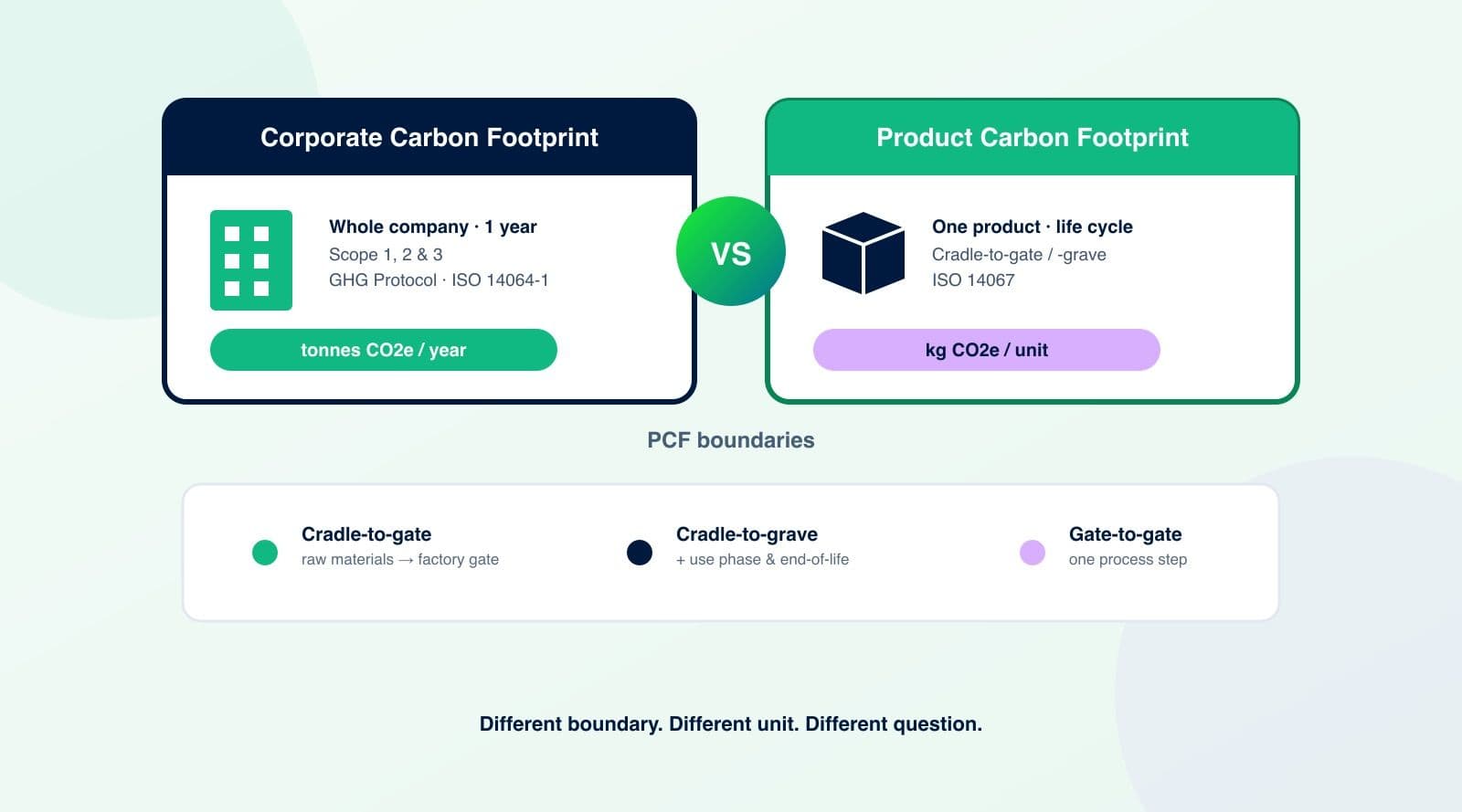
A corporate carbon footprint measures the greenhouse gas emissions of an entire organisation over a reporting period, usually a year. It follows the GHG Protocol Corporate Standard or ISO 14064-1, and it's built around an organisational boundary: every facility, vehicle, and purchased energy source the company owns or controls, split into Scope 1 (direct emissions), Scope 2 (purchased electricity, heat, steam, or cooling), and Scope 3 (everything else in the value chain).
The output is a single figure — total tonnes of CO2e for the year — that represents the whole business, regardless of how many different products it makes. This is the number a bank, an investor, or a corporate customer doing value-chain reporting typically wants, and it's exactly what sits inside the VSME Basic Module's B3 disclosure and most disclosure standards. If you want the full comparison of which standard actually asks for this figure, our guide to VSME, ESRS, GRI, and the GHG Protocol covers that in detail.
Product Carbon Footprint (PCF): Measuring One Product
A product carbon footprint measures the greenhouse gas emissions associated with a single product across some or all of its life cycle, expressed per unit of that product — per kilogram, per litre, per pair, per unit sold. It follows ISO 14067 or the GHG Protocol Product Life Cycle Standard, both built on life cycle assessment (LCA) methodology rather than organisational accounting.
Where a CCF answers "how much did this company emit this year," a PCF answers "how much did it take to make one of these." That's a fundamentally different question, and it's the one increasingly being asked by retailers building eco-labels, procurement teams comparing suppliers on a per-SKU basis, and — soon, for many product categories — EU regulation itself.
The Core Difference: Boundary and Unit of Analysis
Strip away the acronyms and the difference comes down to two things: what you draw the boundary around, and what you divide by.
- Boundary — a CCF draws its boundary around the organisation: every site and activity the company controls, for the whole reporting year. A PCF draws its boundary around a product system: every life-cycle stage that product passes through, from raw materials to (depending on scope) disposal.
- Unit — a CCF is reported in absolute terms: total tonnes of CO2e for the company, for the year. A PCF is reported per functional unit: kg CO2e per item, per kilogram, per use — a figure designed to be comparable between one product and a competing one.
- Standard — a CCF typically follows the GHG Protocol Corporate Standard or ISO 14064-1. A PCF typically follows ISO 14067 or the GHG Protocol Product Standard, both of which build on life cycle assessment principles (ISO 14040/14044) rather than corporate accounting principles.
A useful way to hold the two in your head: a CCF is a snapshot of the company; a PCF is a snapshot of the product, and a company's total emissions in a year are, in effect, distributed across every unit of every product it made — a PCF is one slice of that.
Cradle-to-Gate, Cradle-to-Grave, and Other PCF Boundaries
Because a PCF is built around a product's life cycle rather than a company's operations, you also have to decide how much of that life cycle to include. ISO 14067 requires you to state this explicitly, and three boundaries come up most often:
- Cradle-to-gate — from raw material extraction through to the point the product leaves your factory gate. This is the most common boundary for B2B products and intermediate goods, because the manufacturer doesn't control what happens after the product is sold, and it's the boundary most often used when a business customer asks a supplier for a PCF to feed into their own downstream calculation.
- Cradle-to-grave — the full life cycle, including distribution, the use phase, and end-of-life disposal or recycling. This is more common for consumer products, especially where the use phase is emissions-intensive (appliances, vehicles) or where a brand wants a full-lifecycle claim for marketing or an eco-label.
- Gate-to-gate — a single stage of the life cycle, such as one manufacturing process. This is rarely reported on its own but is used as a building block: a chain of gate-to-gate figures from different suppliers, each covering their own step, is exactly how a cradle-to-gate or cradle-to-grave figure gets assembled across a supply chain.
If a customer asks you for "your PCF" without specifying a boundary, cradle-to-gate is the safe default for a B2B intermediate product — but confirm it, because comparing a cradle-to-gate figure against a cradle-to-grave one from a competitor makes both numbers meaningless.
How PCF Calculation Actually Works
A PCF calculation follows a fairly consistent sequence, whether you do it in a spreadsheet or dedicated LCA software:
- 1. Define the functional unit — the precise unit the footprint is expressed per (one unit sold, one kilogram, one use-cycle), and the boundary (cradle-to-gate, cradle-to-grave, or otherwise).
- 2. Map the product's life cycle — build a bill of materials and process map covering every input and stage inside your chosen boundary: raw materials, processing, packaging, and transport between stages.
- 3. Gather activity data — quantities of each material and energy input per stage, ideally from your own records (primary data) rather than industry averages (secondary data), since primary data produces a more defensible, specific figure.
- 4. Apply emission factors — convert each activity quantity into CO2e using recognised emission factor databases (the same sources used for Scope 1 and 2 corporate accounting apply here too).
- 5. Sum and allocate — total the emissions across all stages within the boundary, then divide by the number of functional units produced to get the per-unit figure.
- 6. Document and, if needed, verify — ISO 14067 expects the methodology, data sources, and boundary to be documented transparently enough for a third party to review, particularly if the PCF will be used in a public claim.
Steps 3 and 4 will look familiar if you've already built a corporate carbon footprint: the same activity data and emission factors that go into your Scope 1 and 2 figures for a CCF are often directly reusable for the manufacturing stages of a PCF. Our guide to cost-effective supplier carbon footprinting covers that Scope 1 and 2 calculation in more detail, and most of that groundwork doesn't need to be redone from scratch once you move from a company-level figure to a product-level one.
Do You Need a CCF, a PCF, or Both?
For most SMEs, the answer is: start with a CCF, and add a PCF when something specific asks for one.
- A bank, investor, or corporate customer doing general ESG due diligence, or a VSME-style report, wants a corporate carbon footprint. That's the company-level figure covered in our VSME Basic Module guide, and for most SMEs it's the natural starting point.
- A retailer building an eco-label, a procurement team comparing suppliers on a per-product basis, or a customer asking specifically for the footprint of one SKU wants a product carbon footprint — a company-wide figure won't answer that question.
- EU regulation is pushing PCF requirements further down the supply chain regardless of who asks first: the Ecodesign for Sustainable Products Regulation is rolling out mandatory Digital Product Passports across product categories from 2026 through 2030, and a PCF calculated to ISO 14067 is set to be the minimum carbon data most categories will need to include.
The practical order that saves the most work is CCF first: it gives you clean Scope 1 and 2 activity data and emission factors across your operations, which then becomes the reusable core of any PCF you build later for a specific product, rather than starting each product calculation from zero.
Sustainly's workflow is built around exactly that reuse — a corporate carbon footprint you can stand up quickly, structured so the underlying data doesn't have to be recollected from scratch the first time a customer or the Digital Product Passport rules ask for a product-level number instead.