Ready to get started?
Transform your ESG reporting with expert support.
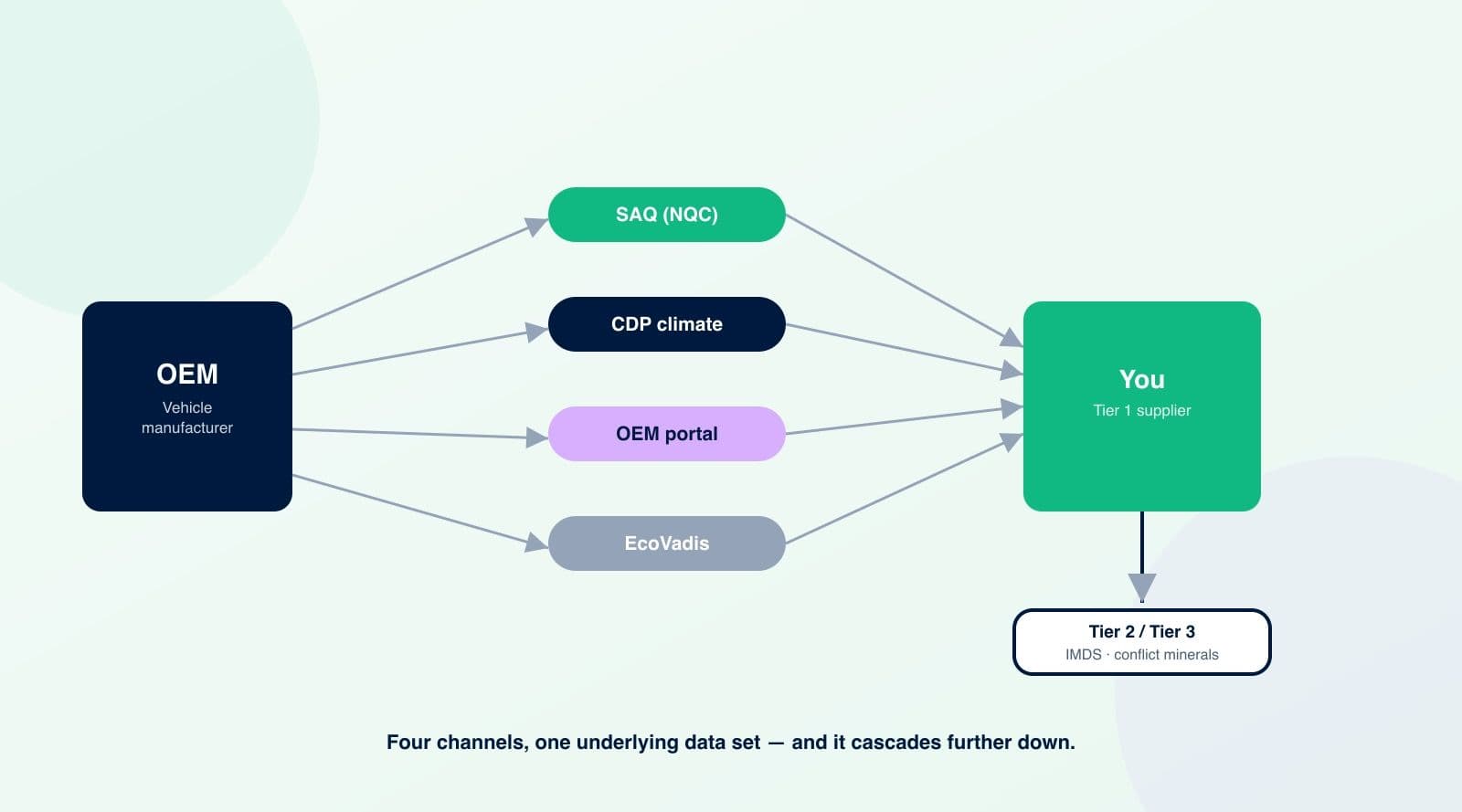
One OEM customer sends you the Drive Sustainability questionnaire through a shared portal. Another wants a CDP climate response by a fixed date. A third has its own proprietary supplier sustainability portal with its own set of questions. A fourth mentions an EcoVadis score. If you're a Tier 1 automotive supplier, this isn't four unrelated problems — it's mostly the same underlying set of ESG requirements for OEM suppliers, arriving through four different channels, some of which genuinely overlap and some of which don't.
This guide untangles what each channel actually asks for, how they relate to each other, and why almost none of this stops with you — Tier 1 supplier sustainability obligations exist precisely because OEMs need the same data from you that you'll eventually need from your own Tier 2 and Tier 3 suppliers.
Drive Sustainability and the SAQ: the Industry's Common Language
Drive Sustainability is an industry initiative founded by a group of major OEMs — including BMW Group, Mercedes-Benz (formerly Daimler), Ford, Honda, Scania, Toyota Motor Europe, Volkswagen Group, and Volvo Cars — built to stop each manufacturer from running its own bespoke supplier sustainability questionnaire. Instead, the group maintains a shared Self-Assessment Questionnaire (SAQ), now at version 5.0, built on the Global Automotive Sustainability Guiding Principles.
The SAQ covers five areas that show up in almost every automotive supplier ESG requirement, however it eventually gets delivered: business ethics and governance, human rights and labour conditions, health and safety, environmental management, and responsible sourcing of raw materials. Several of the founding OEMs deliver the SAQ through a common technical platform run by NQC (SupplierAssurance), which means a supplier who answers once can share that same response with every OEM customer using that shared platform, rather than re-answering an equivalent questionnaire for each one.
That "answer once, reuse many" model is the single most useful fact in this entire space, and it's also the most commonly missed one. If you're re-answering a near-identical questionnaire for three different OEM customers, the first thing worth checking is whether all three actually run it through the shared NQC platform — in which case one properly maintained SAQ response covers all three, not three separate projects.
CDP: the Climate-Specific Ask That Sits Alongside the SAQ
CDP's Supply Chain programme is a separate system from Drive Sustainability, and many OEMs — plus large customers well beyond the automotive industry — use it to request an annual CDP Climate Change questionnaire response from their suppliers. Where the SAQ takes a broad view across governance, labour, environment, and sourcing, CDP goes deep on one thing: quantified Scope 1, 2, and 3 greenhouse gas emissions data, calculated to the GHG Protocol.
The two aren't redundant, even though they can feel that way. The SAQ's environmental section asks whether you have the right policies, management systems, and practices in place; CDP asks for the actual numbers those practices are supposed to produce. If you've already built a corporate carbon footprint for any other reason — a bank, an EU customer's VSME-based request, or your own management reporting — our guide comparing VSME, ESRS, GRI, and the GHG Protocol explains how those emissions figures are calculated once and reused across every one of these requests, CDP included.
Then There's Your Customer's Own Portal
Beyond the shared SAQ and CDP, individual OEMs frequently layer their own proprietary supplier portal on top, with additional requirements that are automotive-specific rather than general ESG:
- IMDS (International Material Data System) — a shared database for submitting the material composition of every part supplied, so OEMs and suppliers across the chain can track regulated substances. It sits alongside ESG requirements rather than inside them, but it cascades through Tier 1, 2, and 3 the same way the SAQ does, and OEM portals routinely bundle it into the same supplier compliance conversation.
- Conflict minerals reporting — due diligence on tin, tantalum, tungsten, gold (3TG), and cobalt, usually documented through the Responsible Minerals Initiative's Conflict Minerals Reporting Template (CMRT) or Extended Minerals Reporting Template (EMRT). This requires tracing sourcing down to identified smelters and refiners, which in practice means collecting the same declaration from your own upstream suppliers.
- EcoVadis scores — an independent third-party sustainability rating, scored 0–100 across four pillars (environment, labour and human rights, ethics, and sustainable procurement), that some OEMs request or accept as an alternative or supplement to the SAQ rather than running their own assessment.
- Drive Sustainability's Raw Materials Observatory and Battery SAQ — a toolbox for identifying risk in mineral supply chains, and, since 2024, a dedicated Battery SAQ reflecting the risk categories in the EU Batteries Regulation, aimed specifically at suppliers in EV battery supply chains.
Why This Cascades to You Even If You're Not the One in the Spotlight
Tier 1 supplier sustainability requirements exist in the middle of a chain, not at the end of one. An OEM asks you for SAQ answers, a CDP response, IMDS material data, and conflict minerals sourcing — and to answer most of those honestly, you need the equivalent information from your own Tier 2 and Tier 3 suppliers. The reporting burden doesn't stop at Tier 1; it passes through you.
If you're also an EU-based supplier separately being asked for VSME or CSRD-related sustainability data by non-automotive customers, worth noting: there's no equivalent "value chain cap" in the automotive ESG ecosystem. The EU's value chain cap legally limits what a CSRD-obligated customer can ask a smaller counterparty for; Drive Sustainability, CDP, and OEM portals aren't bound by that mechanism, so the practical scope of what an automotive customer can request is set by industry convention and contract terms, not a statutory ceiling.
A Practical Way to Handle Multiple Overlapping Requests
Treating each customer request as a separate project is the single biggest source of wasted effort here. A more durable approach:
- 1. Build the corporate carbon footprint once. Scope 1, 2, and 3 figures calculated to the GHG Protocol answer CDP directly and feed the SAQ's environmental section. Our guide to cost-effective supplier carbon footprinting covers that calculation, and if a customer is asking for product-level rather than company-level figures, our comparison of product carbon footprint vs corporate carbon footprint explains when that shift is actually necessary.
- 2. Maintain one master data set — policies, certifications, health and safety records, emissions figures, and sourcing declarations — rather than rebuilding it inside each customer's portal from scratch.
- 3. Map which of your customers share the NQC platform for the SAQ, which run CDP, and which run a fully separate proprietary portal. The shared-platform group often collapses into a single piece of work; treat that as the priority, since it satisfies the most customers per hour spent.
- 4. Push the same discipline down to your own Tier 2 and Tier 3 suppliers early, rather than scrambling for their IMDS or conflict minerals data only after an OEM deadline is already close.
If a specific customer request has landed and you need a structured way to triage and prioritise it, our guide to responding when customers demand supplier sustainability data walks through that process in more general terms, and applies just as well to an OEM's portal as it does to any other customer questionnaire.
Sustainly's workflow is built around that same master-data-set approach — one corporate carbon footprint and one sustainability data set, structured so it can answer a Drive Sustainability SAQ, a CDP request, and a bank or general EU customer's VSME-based request from the same underlying numbers, instead of rebuilding the answer from scratch every time a new portal shows up.