Ready to get started?
Transform your ESG reporting with expert support.
A customer questionnaire or a bank renewal form arrives, and the honest first reaction is rarely "I know exactly what we have and what we don't." It's usually closer to: some of this data probably exists somewhere, some of it we'd have to estimate, and some of it we've genuinely never collected. An ESG gap analysis is just the structured version of answering that question properly, once, instead of guessing it fresh every time a new request arrives.
This guide walks through how to actually run one: what it is, the four-step process that works for a small team without a consultant, and how to turn the result into a prioritised plan rather than a long list of anxieties.
What an ESG Gap Analysis Actually Is
An ESG gap analysis compares two things: the sustainability data a specific standard, customer, or regulation actually requires of you, against the data you can currently produce, with evidence, at the quality that request needs. The gap is the difference between those two lists — not a vague sense that "we should do more," but a specific, named set of missing or weak data points.
Done properly, it's a one-time structural exercise, not something you repeat from scratch for every incoming request. Once you know your gaps against a reasonably comprehensive standard, most individual customer, bank, or portal requests turn out to be subsets of work you've already mapped.
Step 1: Pick the Reference Standard You're Measuring Against
A gap analysis needs a fixed target, not a vague sense of "best practice." For most SMEs, the VSME Basic Module is the right reference point: a defined, finite list of data points — not an open-ended one — that's proportionate to SME size and already the de facto ceiling on what a CSRD-obligated customer can require from you. Our VSME Basic Module guide breaks all 46 of those data points down individually, which doubles as a ready-made checklist for this exact exercise.
If you're already in CSRD scope yourself, or close to the threshold, ESRS is the correct reference standard instead, and it's considerably larger. Our guide to CSRD scope after the Omnibus reforms and our comparison of VSME, ESRS, GRI, and the GHG Protocol help confirm which one actually applies to you before you spend time mapping against the wrong list.
Step 2: Inventory What You Already Have — Honestly
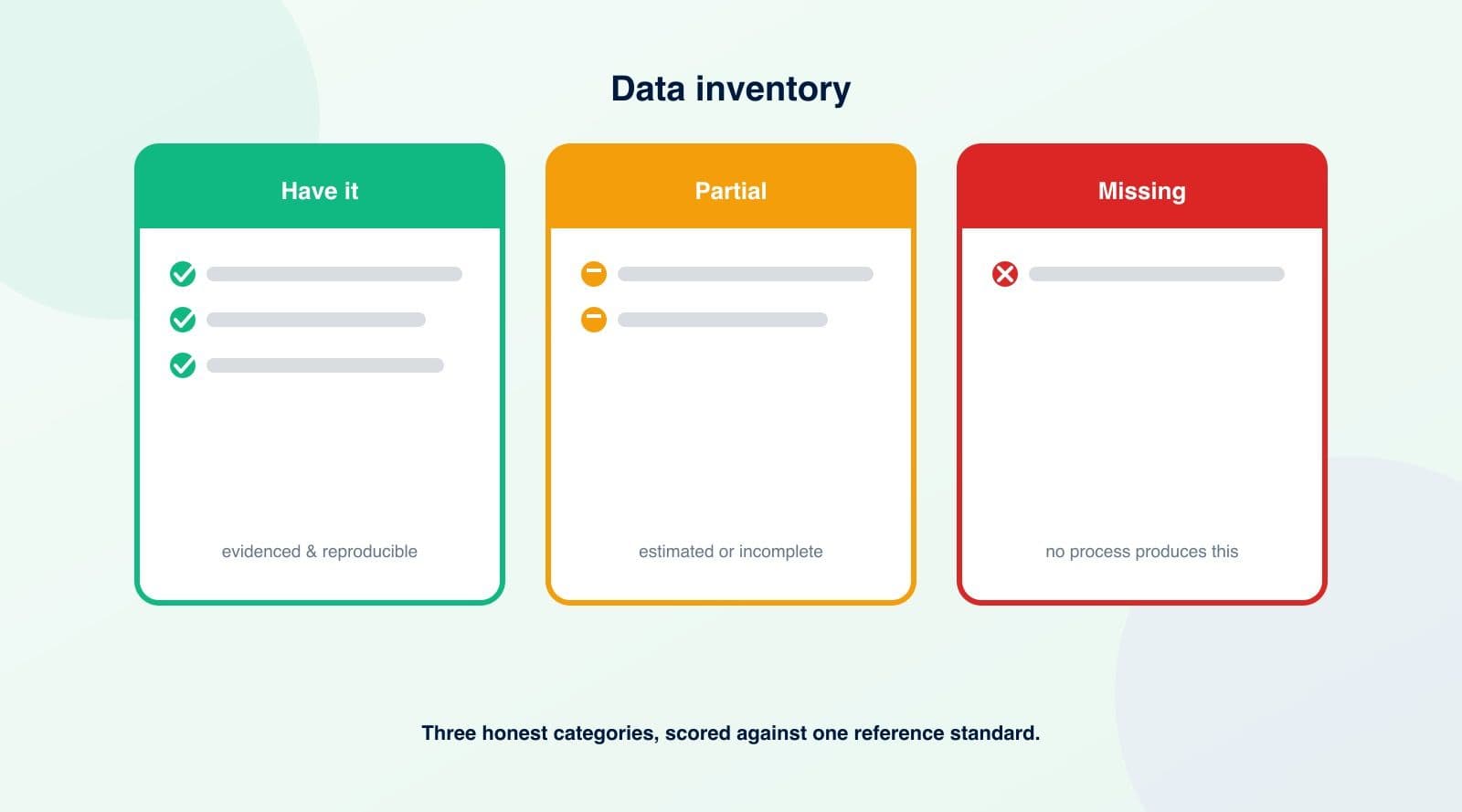
Go through your reference list item by item and sort each data point into one of three honest categories, resisting the urge to round up:
- Have it, and it would survive scrutiny — the data exists, has a clear source, and you could explain where it came from and how it was calculated if a bank or customer asked a follow-up question.
- Partially have it — the data exists but is incomplete, outdated, estimated rather than measured, or scattered across people and systems in a way that nobody has actually assembled into a single figure yet.
- Don't have it at all — no process currently produces this data point, even informally.
The honest version of this inventory asks, for each item: where does this data originate, who owns it, what time period and boundary does it cover, how is it calculated, is any part estimated rather than measured, and could you produce supporting evidence if someone asked? A data point that technically "exists" as a rough mental estimate in someone's head is a gap, not a have — it just doesn't look like one until someone asks you to document it.
Step 3: Where Most SMEs Actually Find Gaps
The pattern repeats enough across SMEs doing this exercise for the first time that it is worth naming directly, so you know where to look first:
- Scope 1 and 2 emissions, calculated rather than estimated — many companies have a rough sense of their carbon footprint but have never actually pulled fuel card and utility invoice data into a real calculation. Our guide to calculating Scope 1 and 2 from invoices and fuel cards covers exactly this gap and how to close it with data you already hold.
- Site-level physical climate risk — geolocation plus hazard exposure for every site, which almost nobody has assembled until a bank or insurer specifically asks for it. Our guide to physical climate risk assessment covers how to close this gap with free public hazard data rather than a paid report.
- Workforce data broken down correctly — headcount or FTE split by contract type, gender, and country is often available in payroll systems but has never been pulled into the specific breakdown a disclosure standard actually asks for.
- Policies that exist informally but aren't documented — many SMEs genuinely have sustainability practices (reducing energy use, treating staff well) without ever having written them down as a named, dated policy a validator or auditor could point to.
- Supplier-level data — conflict minerals declarations, supplier codes of conduct actually cascaded downstream rather than just drafted, and sourcing documentation that exists in principle but has never been collected into one place.
Step 4: Prioritise the Gaps — Don't Try to Close Everything at Once
A full gap list for even a modest standard can look alarming laid out all at once. The fix is prioritisation, not panic. Three questions sort the list usefully:
- Is this data point mandatory or conditional in your reference standard? Mandatory items with no applicability exception come first; conditional items you can genuinely rule out as not applicable to your business can be documented as such and set aside, not treated as open gaps.
- Is someone actually asking for this specific item right now? A gap tied to a live customer or bank request outranks a theoretical one, even if the theoretical one is objectively larger.
- Can you close this gap by assembling data you already hold, or does it require building a new process from scratch? The former is nearly always faster — a Scope 1/2 calculation from existing invoices can often be done in days; a new site-by-site climate risk assessment takes longer but is still usually achievable with free data rather than new measurement infrastructure.
Ranking by those three questions usually produces a short list of two or three gaps worth closing immediately, a medium list worth planning for the next few months, and a longer tail that only matters if a specific future request makes it relevant — which is a far more usable output than one undifferentiated list of everything missing.
Document the "Not Applicable" Items Too
A gap analysis that only lists missing data looks incomplete to whoever reviews it next, including your future self. For every data point you've genuinely ruled out — a conditional item that doesn't apply to your business, a disclosure that only triggers above a size threshold you don't meet — write down why, briefly, with the date you checked. This mirrors exactly how the VSME Basic Module itself asks you to flag omitted disclosures rather than leaving them silently blank, and it saves you from re-litigating the same scoping question next year.
If the Gap Analysis Was Triggered by a Specific Request
Sometimes the gap analysis isn't a proactive exercise — it's the first thing you do after a specific questionnaire lands and you realise you don't have half of what's being asked. Our guide to responding when customers demand supplier sustainability data covers how to triage that specific situation; the gap analysis approach in this article is the same underlying method, just run against a general reference standard instead of one incoming form, so the next request is faster to answer.
Sustainly's workflow is built around exactly this gap-analysis-once, reuse-always structure — map your data against the VSME Basic Module a single time, and the platform tracks which data points are solid, which are partial, and which are still open, so the next customer, bank, or OEM portal request gets answered from a known state instead of starting the inventory over from scratch.