Ready to get started?
Transform your ESG reporting with expert support.
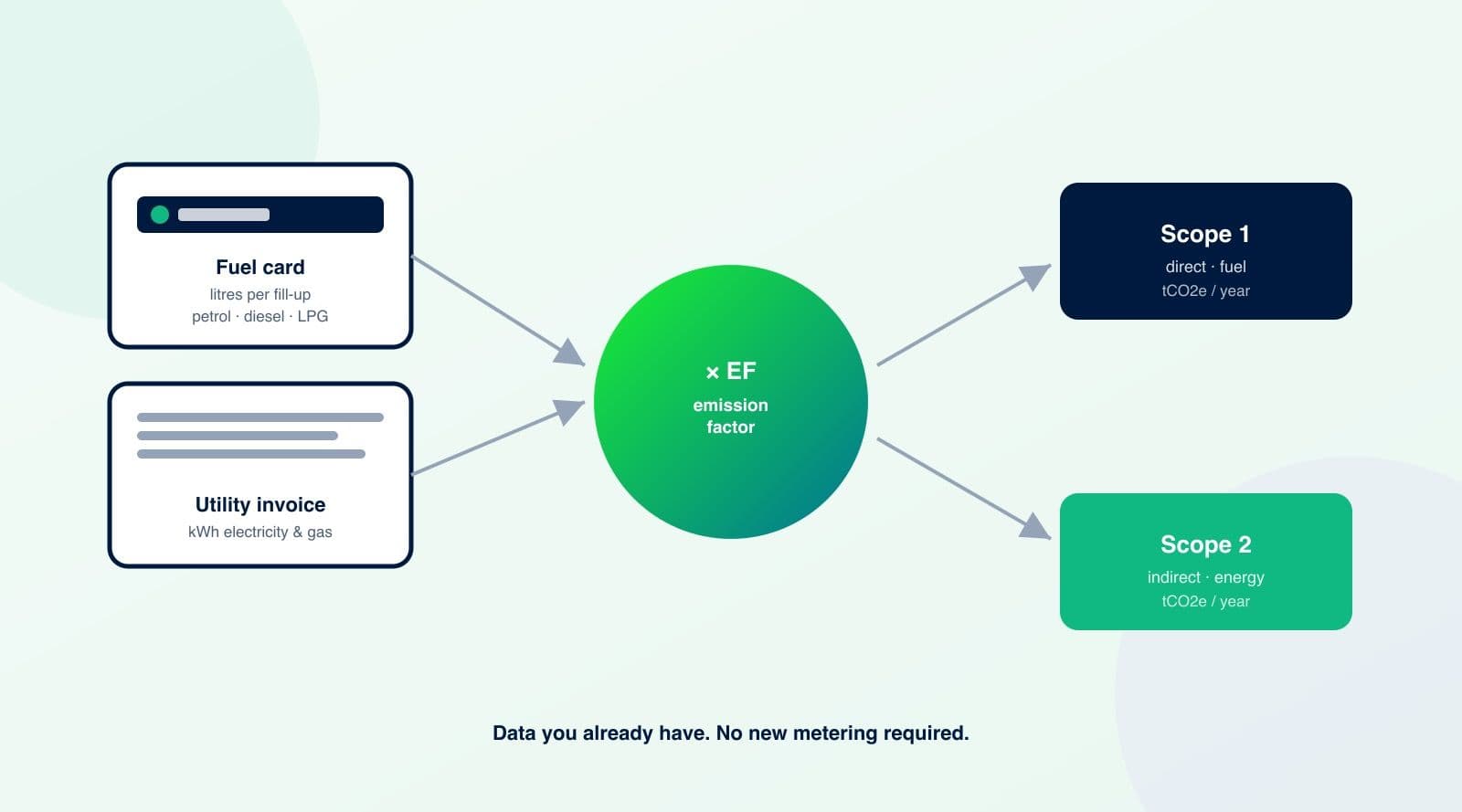
Most SMEs already hold every piece of data needed for a first, defensible Scope 1 and 2 calculation — it just lives in the wrong place. Fuel card statements sit in accounts payable. Electricity and gas invoices sit with whoever pays the utility bills. Nobody's ever pulled them together and multiplied them by anything, because nobody's asked until now.
This guide walks through exactly how to turn those two ordinary paper trails — fuel cards and utility invoices — into a Scope 1 and 2 figure that follows the GHG Protocol, with no new equipment, no site audits, and no consultant required for the first pass.
Scope 1 and 2 in One Paragraph
Scope 1 covers direct emissions from sources your company owns or controls — fuel burned in your own vehicles, boilers, generators, and on-site equipment. Scope 2 covers indirect emissions from energy you purchase and consume — mainly electricity, but also purchased heat, steam, or cooling. The dividing line is simple: if you bought and burned the fuel yourself, it's Scope 1; if someone else generated the energy and you bought it, it's Scope 2.
For most SMEs without heavy industrial processes, that means Scope 1 is almost entirely fuel — company vehicles, vans, forklifts, and any on-site heating that runs on gas or oil — and Scope 2 is almost entirely electricity. Which is exactly why fuel cards and utility invoices, two things every finance team already has, cover most of the calculation.
What You Need Before You Start
Gather these before doing any maths — half the work is just assembling the right documents in one place:
- Fuel card statements for the full reporting period (usually a financial year), for every vehicle and card on the account, showing litres or gallons purchased per fill-up — not just the amount spent in currency.
- Fuel receipts or delivery notes for any fuel bought outside a card scheme — bulk heating oil deliveries, gas cylinder refills, or cash fuel purchases for owned equipment.
- Electricity invoices for every metered site for the full period, ideally showing kWh consumed, not just the bill amount.
- Gas invoices for any site with mains gas heating, again in kWh or m³ rather than currency.
- A recognised emission factor set for the year and country in question — in the UK, the DESNZ (formerly BEIS/Defra) conversion factors published annually on GOV.UK; in the US, the EPA's Emission Factors Hub, which draws on eGRID for electricity; most other countries have an equivalent national or IEA-published figure.
The single most common stumbling block is that invoices show a bill in euros or pounds, not a quantity in litres or kWh. If your statements only show cost, go back to the supplier portal or ask the supplier directly for a usage breakdown — you cannot convert currency into emissions, only physical quantity.
Calculating Scope 1 from Fuel Card Data
Fuel card data converts to Scope 1 emissions in three steps:
- 1. Total the fuel volume by type. Sum every litre of petrol separately from every litre of diesel, and separately again from any LPG, heating oil, or other fuel — emission factors differ by fuel type, so they cannot be combined before conversion.
- 2. Apply the matching emission factor. Multiply total litres of each fuel type by that fuel's specific emission factor (in kg CO2e per litre) from your chosen factor set for the reporting year. A litre of diesel and a litre of petrol have different factors, and using last year's factor set for this year's data introduces avoidable error, since factors are revised annually.
- 3. Sum across fuel types. Add the resulting kg CO2e figures for petrol, diesel, and any other fuels together to get your total Scope 1 fuel emissions for the period, then convert to tonnes CO2e by dividing by 1,000.
If you also run on-site heating from a gas boiler rather than mains electricity, that gas consumption is Scope 1 too, not Scope 2 — because you're burning the fuel yourself on-site, not purchasing already-converted energy. Pull that from the gas invoice in kWh or m³ and apply the appropriate natural gas emission factor the same way.
Calculating Scope 2 from Utility Invoices
Scope 2 electricity is more straightforward, with one decision to make first: whether to calculate it location-based, market-based, or both. Location-based uses the average emissions intensity of the grid your site draws from; market-based reflects any specific electricity contract or renewable energy certificates you hold. The GHG Protocol Scope 2 Guidance recommends reporting both where you have a market-based figure to offer, and location-based alone if you don't have a specific supply contract with its own emission factor.
- 1. Total electricity consumption in kWh across all metered sites for the reporting period, pulled directly from invoices rather than estimated from spend.
- 2. Apply the grid emission factor for your country and year (location-based) — for example, the DESNZ factor for the UK or the eGRID-derived factor from the EPA hub for the US, matched to the specific sub-region if your factor set provides one.
- 3. If you hold a green tariff, power purchase agreement, or renewable energy certificates, calculate the market-based figure separately using your supplier's residual mix or certificate-specific factor, and report it alongside the location-based number rather than instead of it.
- 4. Convert the resulting kg CO2e to tonnes by dividing by 1,000, matching the unit you used for Scope 1 so the two figures can be added together for a combined total.
One detail worth flagging because it trips people up: electricity emission factors move a lot year to year as national grids add renewable capacity, and recent methodology changes in several countries have made that swing even larger between reporting years. Always use the factor published for the specific year you're reporting on, not whatever factor set you last downloaded.
A Worked Example
Say a small logistics company has three diesel vans on a fuel card, plus a warehouse on mains electricity and gas heating. Over the year, the fuel card shows 8,400 litres of diesel purchased. The electricity invoices show 42,000 kWh consumed. The gas invoices show 18,000 kWh consumed.
- Scope 1 (diesel): 8,400 litres × diesel emission factor ≈ Scope 1 transport emissions in kg CO2e.
- Scope 1 (gas heating): 18,000 kWh × natural gas emission factor ≈ Scope 1 heating emissions in kg CO2e, added to the transport figure for total Scope 1.
- Scope 2 (electricity): 42,000 kWh × grid electricity emission factor for the reporting year ≈ total Scope 2 emissions in kg CO2e.
The exact factors change annually and by country, so this deliberately doesn't quote a final number — the structure of the calculation is identical regardless of which year's factors you plug in, which is the whole point: once you've built the spreadsheet once, next year's calculation is the same formula with new fuel and electricity totals and a refreshed factor set.
Common Mistakes That Undermine the Figure
- Converting spend instead of quantity — using currency amounts with an emission factor meant for litres or kWh produces a number with no real meaning, since fuel and electricity prices change independently of consumption.
- Mixing fuel types before applying factors — petrol, diesel, and LPG all have different carbon intensities per litre; total them separately, then convert.
- Using a stale emission factor set — applying last year's factors to this year's data, particularly for electricity, where the factor itself has been known to shift meaningfully within a single year.
- Missing off-card fuel purchases — bulk heating oil deliveries or cash fuel purchases for site equipment often don't run through the fuel card and get left out entirely unless you specifically go looking for them.
- Reporting only market-based Scope 2 — a market-based figure is useful, but if it comes from certificates rather than a genuinely lower-carbon contract, quoting it alone without the location-based number understates your actual grid draw.
Where This Fits Into a Bigger Report
Once you have Scope 1 and 2 totals, they become the core carbon-related data points in almost every disclosure standard an SME is likely to face — the B3 energy and emissions disclosure in the VSME Basic Module, the underlying figure behind a CDP climate response, and the starting point for any customer or bank asking for a carbon footprint at all. Our VSME Basic Module guide shows exactly where these numbers slot into that broader checklist, and our comparison of VSME, ESRS, GRI, and the GHG Protocol explains how the same Scope 1 and 2 figures get reused across whichever standard actually applies to you.
This company-level figure is also the reusable base for anything more specific a customer asks for later. If a request narrows down to a single product rather than the whole company, our guide to product carbon footprint vs corporate carbon footprint explains when that shift is actually necessary, and the same fuel and electricity activity data you've already gathered here becomes the manufacturing-stage input for that calculation too — nothing about this exercise gets thrown away once you move beyond Scope 1 and 2.
If a customer or bank has already asked you for this figure directly, our guide to cost-effective supplier carbon footprinting covers the same calculation from that angle. Sustainly's workflow automates exactly this process — pulling fuel and energy data into one place and applying the current year's emission factors automatically, so the spreadsheet you'd otherwise rebuild every year becomes a five-minute update instead.