Ready to get started?
Transform your ESG reporting with expert support.
You've received an invitation to complete the Drive Sustainability Self-Assessment Questionnaire (SAQ) through NQC's SupplierAssurance platform. The questions themselves are manageable. What trips people up is everything around the questions: which ones actually apply to you, how the answers get turned into a score, and why a confident "yes" sometimes still comes back as a gap.
This guide walks through how to actually answer the SAQ well, not just complete it. For background on what Drive Sustainability is and how the SAQ sits alongside CDP and OEM portals, our broader guide to automotive Tier 1 supplier ESG requirements covers that landscape; this article goes one level deeper into the mechanics of the questionnaire itself.
The Questionnaire Adapts to You — Get the First Two Answers Right
SAQ 5.0 is a materiality-based, adaptive questionnaire. It does not ask every supplier the same set of mandatory questions. Based on two inputs you provide at the start — your number of employees and your NACE industry classification code — the platform determines which sustainability topics are actually material to a company your size and sector, and makes those questions mandatory while leaving others optional or not applicable.
That makes the headcount and NACE code fields the most consequential two answers in the entire questionnaire, and the ones most commonly rushed. Getting your NACE code wrong — picking a close-enough category instead of the precise one for your actual activity — can pull in mandatory questions about hazards or processes you don't actually have, or worse, leave out ones that genuinely apply to you. Confirm both before answering anything else, not after.
How the SAQ Is Scored — and What A Through F Actually Means
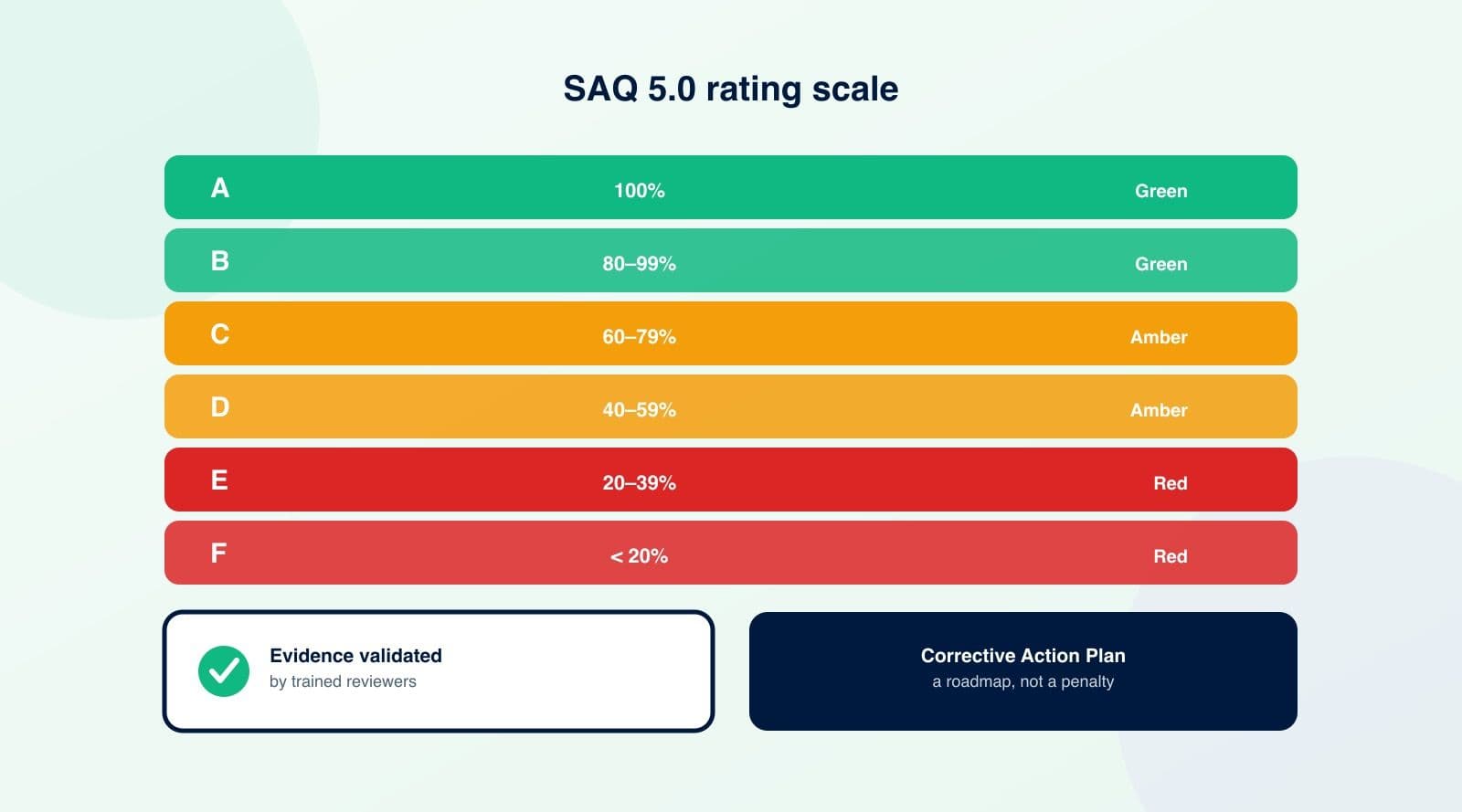
Once submitted, the SAQ produces two numbers: a Sustainability Score, a percentage reflecting your performance across all the mandatory questions you answered, and an SAQ Rating, a letter grade from A to F derived from that score against the mandatory questions for your specific sector and size.
- A — 100% (Green)
- B — 80–99% (Green)
- C — 60–79% (Amber)
- D — 40–59% (Amber)
- E — 20–39% (Red)
- F — below 20% (Red)
The colour band matters as much as the letter in practice. Many OEM customers set an internal expectation around the Amber-to-Green boundary, and a Red result commonly triggers a follow-up conversation rather than simply sitting quietly in a file. You can see your rating, plus a section-by-section breakdown, on the Overview screen of your completed questionnaire in the NQC platform — it's worth reviewing that breakdown rather than just the headline letter, since it shows exactly which of the five sustainability areas is pulling the score down.
Evidence: the Part That Actually Determines Your Score
Answering "yes" to a question is not the same as the question being scored as met. The SAQ requires supporting evidence for many mandatory answers, and that evidence is checked by trained validators for quality and applicability before it counts toward your score — not just whether a document exists, but whether it actually supports the specific claim you made.
The practical trap: a confident "yes" with no evidence attached, or evidence that's outdated, generic, or doesn't match what was actually asked, can come back scored as unmet. Gather your evidence before you start the questionnaire, not while you're mid-way through it — scrambling to find a document partway through a section is where rushed, weak evidence gets attached and scores suffer.
Section by Section: What Good Evidence Looks Like
Across the five sustainability areas the SAQ covers, the evidence that actually holds up under review tends to follow a pattern — specific and dated, not generic and undated:
- Business ethics and governance — a signed code of conduct, a named anti-corruption policy, and a documented whistleblowing or grievance procedure, not a general statement that the company "acts ethically."
- Human rights and labour — a policy explicitly covering child labour and forced labour, working-hours records, and a documented grievance mechanism for your own workforce.
- Health and safety — a formal H&S policy plus actual accident and incident records (the rate, not just a statement that none occurred), and any relevant certification such as ISO 45001 if you hold it.
- Environment — an environmental policy, energy and GHG emissions data broken down by Scope 1 and 2 rather than a single estimated total (our guide to calculating Scope 1 and 2 from invoices and fuel cards covers exactly how to produce that data), waste and water management records, and an EMS certification such as ISO 14001 where applicable.
- Responsible sourcing of raw materials — conflict minerals due diligence documentation (typically a completed CMRT), a supply chain mapping exercise, and evidence that your own supplier code of conduct has actually been cascaded to your Tier 2 and Tier 3 suppliers, not just drafted.
The Corrective Action Plan Isn't a Failing Grade
Every supplier who completes the SAQ receives a Corrective Action Plan (CAP) alongside their score, containing specific recommendations for improvement. It is a standard part of the process, not a penalty — treat it as a prioritised roadmap rather than something to file away.
The practical reason to actually work through it: OEM customers can see your rating and, in many relationships, your progress against outstanding items when your assessment is next reviewed or renewed. Closing two or three CAP items before your next reassessment is a more efficient use of time than trying to perfect every section in one pass the first time around.
One Response, Multiple OEMs — Getting the Reuse Right
The whole reason the SAQ runs through a shared platform is so one properly maintained response can be shared with every OEM customer using that same platform, instead of repeating the exercise for each one. Our broader guide to automotive ESG requirements covers that reuse model in more detail — the part worth checking specifically here is your sharing permissions: confirm each relevant OEM customer is actually set to receive your response, since a completed SAQ that isn't shared with a particular buyer does that customer no good at all.
A Practical Checklist Before You Submit
- Confirm your employee headcount and NACE code are accurate before answering anything else — they determine which questions are mandatory for you.
- Gather evidence first: policies, certifications, training and accident records, GHG figures, and sourcing declarations, before you start working through the sections.
- Avoid generic "not applicable" answers without a specific reason — an explained exclusion holds up to validator review far better than a blank or vague one.
- Review the section-by-section score breakdown once available, not just the overall letter rating, to see where the gaps actually are.
- Set sharing permissions correctly so every OEM customer who needs your response can actually see it.
- Note your reassessment timing so the next renewal isn't a scramble — treat the SAQ as a maintained document, not a one-off form.
The underlying evidence behind most of a strong SAQ response — your GHG emissions figures, your policies, your sourcing documentation — is the same material that also answers a CDP request or a customer's general ESG questionnaire. Sustainly's workflow is built to maintain that evidence once and reuse it across the SAQ, CDP, and any other request that lands, so the groundwork from this questionnaire doesn't have to be rebuilt the next time a different portal asks for it.