Ready to get started?
Transform your ESG reporting with expert support.
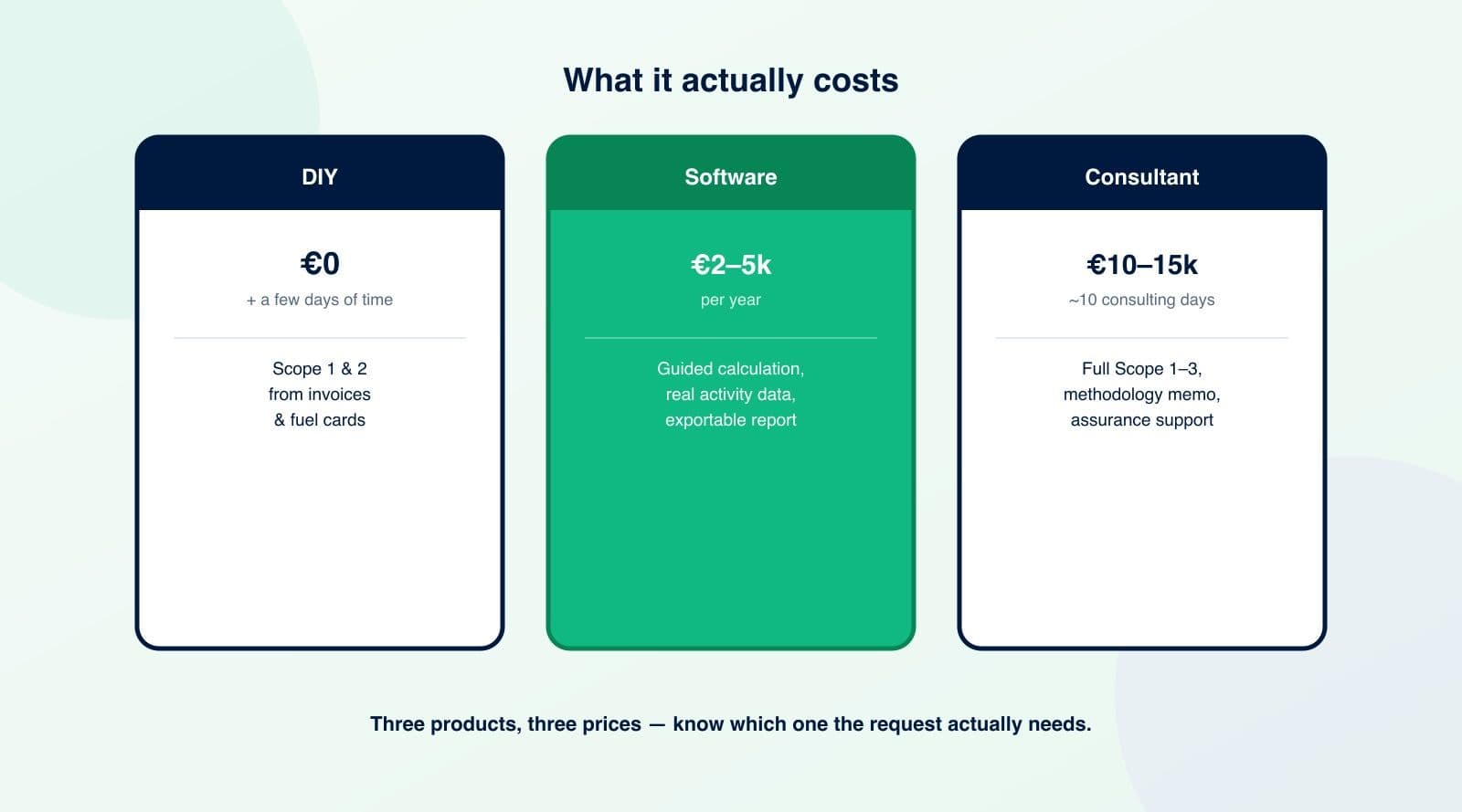
Ask three people what a carbon footprint calculation costs and you'll get three very different answers — nothing, a few thousand euros, or well into five figures. All three can be correct, because they're describing different products: a spreadsheet exercise done in-house, a self-service software platform, and a fully consultant-led assessment with Scope 3 coverage. The price difference is real, and so is the difference in what you actually get for it.
This guide breaks down what each option actually costs, what's included at each price point, and — the part that matters most for most SMEs — which level of spend is genuinely necessary for the kind of request you're likely facing.
The Three Ways to Get a Carbon Footprint Calculated
Almost every option on the market sits in one of three categories, and the price gap between them is large enough that knowing which one you need before you start shopping saves real money.
Option 1: Do It Yourself — Time Cost, Not Cash Cost
For Scope 1 and 2 emissions specifically, a DIY calculation from fuel card statements and utility invoices, using free government-published emission factors, has no direct cash cost at all — only staff time. Our guide to calculating Scope 1 and 2 from invoices and fuel cards walks through exactly how, and for a business with a handful of sites and vehicles, the actual calculation is realistically a few days of someone's time, not weeks.
The limitation isn't accuracy — a properly sourced DIY calculation using real activity data is methodologically sound — it's scope and bandwidth. DIY works well for Scope 1 and 2. Scope 3, which covers your entire value chain, is harder to do well without either dedicated time or a tool built for it, which is where the paid options start to earn their cost.
Option 2: Software and Platform-Supported Calculation
Self-service carbon accounting platforms typically run somewhere in the range of €2,000 to €5,000 per year for an SME. What that buys you is structure: guided data entry, built-in and regularly updated emission factors, calculation logic you don't have to build yourself, and an exportable report in a format banks, customers, or disclosure standards recognise.
The one thing worth checking carefully at this price point is what the tool actually calculates from. Platforms that estimate emissions purely from financial spend data — multiplying what you spent by a generic industry emission factor — are typically at the cheaper end of this range, but produce a number with wide uncertainty bands that doesn't hold up well if a bank or customer asks a follow-up question. Tools that work from real activity data — litres of fuel, kWh of electricity, actual quantities rather than spend — cost more to use properly but produce a figure you can actually defend.
Option 3: Full Consultant-Led Assessment
A comprehensive, consultant-led first carbon footprint — typically covering Scope 1, 2, and a meaningful slice of Scope 3 — commonly costs in the region of €10,000 to €15,000 in the EU, often cited as roughly ten consulting days of work. In the UK, narrower-scope consultant projects start lower, from under £1,000 for a limited assessment up to several thousand pounds, with full Scope 1–3 engagements running comparably to the EU range once complexity and company size scale up.
What that price buys beyond the number itself: a defined organisational and operational boundary set correctly the first time, Scope 3 category screening across your value chain, a methodology memo that explains every assumption, and often support with a specific framework or audit requirement. It's the right spend when your value chain is genuinely complex, when a specific customer or investor has demanded third-party rigour, or when you need Scope 3 coverage and don't have the internal bandwidth to build it yourself.
What Actually Drives the Price Within Each Option
Inside any of these three categories, a few factors explain most of the price variation you'll see between quotes:
- Scope coverage — Scope 1 and 2 only is cheaper and faster than adding Scope 3, which requires mapping an entire value chain rather than your own operations.
- Product-level vs company-level — a figure for your whole company is a different, usually cheaper exercise than a per-product carbon footprint, which requires life-cycle assessment methodology. Our guide to product carbon footprint vs corporate carbon footprint explains that distinction and when the more expensive option is actually necessary.
- Number of sites and operational complexity — a single-site business with one energy supplier is a faster, cheaper calculation than a multi-site operation with varied equipment and processes.
- Verification or assurance — a figure that needs third-party verification or limited assurance for a specific disclosure requirement costs more than an internal-use estimate.
- One-off vs ongoing — a first-year calculation typically costs more than subsequent years, since the structural work (boundary-setting, data source mapping) doesn't need repeating, only updating.
What Most SMEs Actually Need
The honest answer for most SMEs facing a bank renewal, a customer sustainability questionnaire, or a VSME-based report: a properly calculated Scope 1 and 2 figure, built from real invoice and fuel card data, covers what's actually being asked for in the large majority of cases — and that's achievable largely with time rather than a five-figure consultant invoice. Our guide to ESG gap analysis is a useful first step to confirm exactly which data points a specific request actually requires before paying for more than you need.
The full consultant-led route earns its price when the request genuinely calls for Scope 3 coverage, product-level figures, or third-party assurance — but committing to that spend before confirming it's actually required is the single most common way SMEs overpay for this. Our guide to cost-effective supplier carbon footprinting covers how to scope a specific customer request accurately before deciding what level of spend it actually warrants.
Sustainly sits deliberately in the middle of these three options: structured, guided calculation from real activity data rather than spend estimates, at a fraction of a full consultant engagement, built specifically for the Scope 1 and 2 plus VSME-level reporting that covers what most SME customers, banks, and standards actually ask for.
